
South Lake Tahoe, CA · Garage Door Service
Is That 1970s Door Still Doing Its Job
Most South Lake Tahoe garage doors date to the 1970s and have carried decades of heavy snow and freeze-thaw. Here's how to judge if yours is worth repairing.
- Repairs & new doors
- Springs & openers
- Serving 4 nearby communities
What Local Conditions Do
South Lake Tahoe sits in a cold climate band the severe end of it, and that matters more for a garage door than most people think. Steel contracts in deep cold, which changes how much tension a torsion spring is actually carrying from one month to the next. A spring wound to spec in July is not doing the same work in January. Repeated freeze-thaw cycling also works on wood trim and jambs around the opening, swelling and shrinking them enough over the years that doors stop sitting square in their tracks. Snow load adds its own wear, pressing on panels and pushing moisture into seams that were sealed tight when the house was new. None of this is dramatic on any single day. It's cumulative. A door built for this town's weather in the 1970s was engineered to a standard that has moved on, and forty-plus winters of that cycle leave marks you can't always see from the driveway: hairline fatigue in the spring coil, rust starting at a bolt head, a track bracket that's shifted a sixteenth of an inch. By itself none of that is an emergency. Together, over this many winters, it's why the door feels different than it did ten years ago.
When It Stops Being a DIY Job
A torsion spring under tension is dangerous to touch under any conditions, and cold makes it worse because the steel is less forgiving and the hardware is more likely to be rust-locked from years of winter moisture. If a spring looks stretched, has a visible gap in the coil, or the door has gotten noticeably heavier to lift by hand, that's a call-a-pro job, not a weekend one. Same goes for cables that look frayed or a drum that's cracked. Here's the honest limit: we don't walk a homeowner through spring replacement over the phone, and we won't pretend a youtube video and a pair of channel locks make that job safe on a house built in the 1970s with original hardware sizes that may not match what's on the shelf today. What you can reasonably handle yourself is lubricating rollers and hinges, clearing debris from the track, and checking that weatherstripping is still sealing - all low-risk and worth doing before winter sets in hard. The line is tension. Anything holding mechanical load under spring pressure is not a DIY repair here, regardless of how simple it looks once the cover plate is off.
What Is Going On
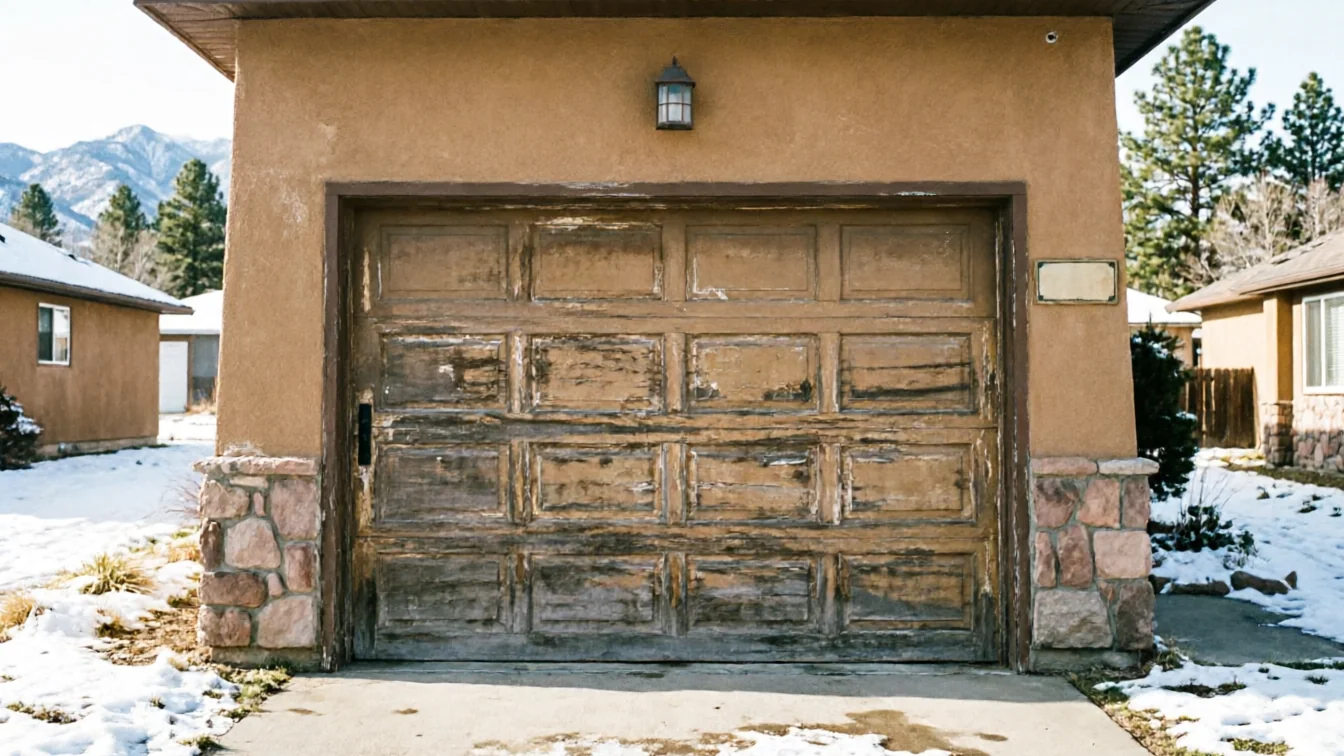
Most garage doors in South Lake Tahoe went up between 1972 and 1978, which puts the bulk of the town's housing stock, spread across four neighborhoods built out in that same era, on roughly the same hardware generation. That matters because a torsion spring has a rated cycle life, and a door original to a house built in 1973 has had about fifty winters of expansion and contraction to use that life up. The failure isn't usually sudden. It shows up as a door that needs an extra push, an opener that strains on cold mornings, or a spring that's visibly stretched further than its neighbor. Panels from that build era are often thinner steel than what's installed today, and after decades of snow load and freeze-thaw they can bow slightly at the bottom section where moisture collects. Track alignment drifts too, usually because the slab or framing around the opening has shifted a little with repeated ground freeze. None of this means the door is junk. It means the parts are old, sized to a 1970s spec, and have done the job they were built to do for longer than most appliances in the house.
When Waiting Is Fine
Not everything on an older door needs attention before the next storm. A dent in a lower panel that doesn't affect how the door seats is cosmetic - fix it when you repaint, not before. A little extra noise on opening, if the door still travels smooth and level, is usually just dry hinges, and a shot of lubricant will quiet it down without a service call. Minor gaps in weatherstripping that aren't letting in daylight can wait until a stretch of mild weather makes the job easier, rather than rushing it mid-storm. The one thing we'd flag even in the
Frequently asked questions
How long do garage door springs last in South Lake Tahoe's climate?
There's no fixed number we can promise, since it depends on cycle count and how the door was maintained, but a torsion spring original to a house built in the 1970s has been through roughly fifty winters of cold-driven expansion and contraction. If yours has never been replaced, it's well past due for an inspection even if it hasn't failed yet.
Is it normal for an older door to feel heavier in winter?
Yes, to a point. Steel contracts in deep cold, which changes spring tension slightly, and a door that's borderline balanced in summer can feel noticeably heavier once the temperature drops. If it's gotten dramatically harder to lift by hand, that's worth a call rather than just living with it.
Should I replace the whole door or just fix what's broken?
That depends on what's actually failing. A worn spring or a bent roller on an otherwise sound 1970s door is usually a repair, not a replacement. If the panels themselves are bowed from decades of snow load or the track alignment has shifted with the foundation, repair stops making financial sense and replacement is the better call.
Related garage door services in South Lake Tahoe
More garage door guides
Book garage door service in South Lake Tahoe
Call now or request a quote - tell us what the door is doing and where you are.